School Lapel Pins: A Complete Guide to House Pins, Prefect Badges and Award Pins for Schools in India
Every school runs on recognition. A student who is made a prefect, wins the inter-house debate, tops the class or represents the school at a state-level tournament needs something visible that marks the achievement. A school lapel pin does exactly that.
Unlike a certificate that goes into a file, a lapel pin is worn. It sits on the blazer or shirt every single day, reminding the student and everyone around them of the role or achievement it represents.
Schools in India use lapel pins and badges for house identity, student leadership positions, staff identification, academic awards, sports achievements, annual day functions and alumni events.
This guide explains the different types of school badges and lapel pins, which materials and backings are appropriate for students, how to design them correctly, what drives the cost, and how to place a bulk order without running into problems.
What Are School Lapel Pins?
A school lapel pin is a small customised metal or enamel badge worn on a blazer, shirt, tie or uniform pocket. It typically carries one or more of the following:
- The school crest or logo
- The school name or motto
- A house name and house colour
- A student leadership designation such as Prefect, Head Boy or Head Girl
- An achievement, subject or activity symbol
- A year or batch number
The purpose is identification and recognition. A good school badge should be readable from a short distance, durable enough for daily school use, comfortable to wear and consistent with the school’s visual identity.
Types of School Lapel Pins and Badges
Most schools do not need a single badge. They need a small system of badges that work together. Here is how the common categories are usually structured.
| Badge Type | Who Wears It | Typical Purpose | Usual Quantity |
|---|---|---|---|
| House pin | All students | House identity and inter-house events | Very high |
| Prefect badge | Selected senior students | Student leadership and authority | Low to medium |
| Head Boy / Head Girl badge | One or two students | Highest student office | Very low |
| Monitor / class representative | One or two per class | Class-level responsibility | Medium |
| Captain / Vice-captain pin | House and sports leaders | House and team leadership | Low |
| Staff name badge | Teachers and support staff | Identification for parents and visitors | Medium |
| Academic award pin | Toppers and subject achievers | Annual academic recognition | Low to medium |
| Sports and activity pin | Team members and winners | Sports day and competition recognition | Medium |
| Alumni pin | Former students | Alumni meets and reunions | Variable |
1. House Pins
Almost every Indian school runs a house system, usually four houses distinguished by colour and often named after rivers, mountains, freedom fighters or values.
House pins are the highest-volume badge a school orders, because every student in the school may need one. The design is usually simple: the house name, the house colour as the dominant enamel fill, and the school crest or initials.
Because the quantity is high, this is also where the cost per piece matters most. Soft enamel or printed finishes are commonly used here to keep large orders economical.
2. Prefect, Head Boy and Head Girl Badges
Leadership badges carry more visual weight. These are worn by a small number of students and are often treated as the most prestigious badge in the school.
Schools frequently choose a more premium finish for these: hard enamel with a polished gold or silver plating, a slightly larger size, and sometimes a different shape from the standard house pin so that the hierarchy is visually obvious.
Many schools also order these with the academic year engraved or printed, so the badge becomes a keepsake the student retains after handing over the role.
3. Monitor and Class Representative Badges
These sit between house pins and prefect badges in both quantity and prestige. A simple die struck or soft enamel badge with a clear designation works well.
A practical tip: keep the designation text large and the decorative elements minimal. A badge that reads “MONITOR” clearly from two metres away is more useful than an ornate one that is hard to read.
4. Teacher and Staff Name Badges
Staff identification is increasingly important in schools, particularly for parent-teacher meetings, admission days, annual functions and security purposes.
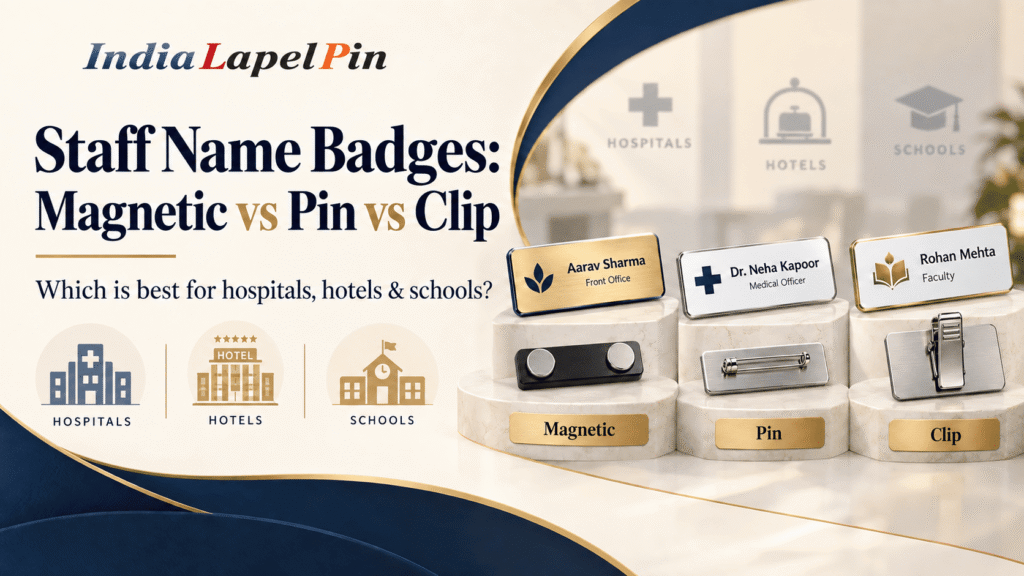
A school staff badge usually carries the teacher’s name, their role or subject, and the school logo. The attachment choice matters here, since teachers wear a wide range of clothing rather than a fixed uniform. Our detailed comparison of magnetic, pin and clip staff name badges covers which backing suits which situation.
5. Academic and Achievement Award Pins
Award pins are given for academic performance, perfect attendance, reading milestones, olympiad results, science fair wins and similar achievements.
These work best as a series. A school can design one base shape and vary the colour or a small symbol for each category, which keeps design costs down while still giving each award a distinct identity.
6. Sports and Annual Day Pins
Sports days and annual functions often need recognition items at several levels. Lapel pins work well for team membership and participation, while custom medals and sports trophies are typically used for podium positions.
7. Alumni Pins
Alumni pins are usually ordered in smaller quantities for reunions and alumni association events. Because they are worn occasionally rather than daily, schools often choose a premium hard enamel or 3D finish for these.
Material and Finish Options for School Badges
The finish decides how the badge looks, how long it lasts and what it costs. These are the options schools most commonly choose between.
Soft Enamel
Soft enamel gives a textured surface where the metal lines sit slightly raised above the colour. It is the most widely used option for school house pins because it reproduces colours well and is economical at high volumes.
Hard Enamel
Hard enamel is polished flat so the surface is smooth and the finish looks more premium. It is more durable and more resistant to scratching, which suits leadership badges and award pins that students are expected to keep.
Die Struck Metal
Die struck pins use no colour fill at all, relying on the raised and recessed metal alone. A die struck gold or silver badge can look dignified and formal, which works well for senior leadership and honour society style badges.
Printed or Epoxy-Coated Pins
When a school crest contains fine detail, gradients or many colours, a printed finish reproduces it more accurately than enamel. A clear epoxy dome can be added for protection.
Our comparison of hard enamel vs soft enamel vs die struck pins explains these differences in more detail with the trade-offs for each.
Which Pin Backing Is Safe for School Students?
This is the question schools most often get wrong, and it matters more in a school than in a corporate setting because the wearers are children.
| Backing Type | Security | Suitability for Students |
|---|---|---|
| Butterfly clutch | Good | Common and practical for older students |
| Rubber or PVC clutch | Good | Softer grip, less sharp than metal clutches |
| Safety pin / brooch bar | Very good | Pin is enclosed when closed; widely used on uniforms |
| Magnetic backing | Moderate | No pinhole, but check school policy and age group |
| Screw back / locking clutch | Excellent | Hard to lose; good for badges that must not be removed |
Practical Guidance by Age Group
Primary school: Younger children are more likely to remove, lose or play with a badge. Safety pin style backings or magnetic options reduce exposure to a sharp open point, though magnetic backings should only be used where the school is comfortable with small magnetic components and supervision is adequate.
Middle and senior school: Standard butterfly or rubber clutch backings are generally practical. Locking clutches are worth the small extra cost for prefect and leadership badges, which are expensive to replace and easy to lose.
Staff: Teachers usually prefer magnetic or clip backings because they do not pierce clothing and can be moved between garments easily.
Whatever the school chooses, it is worth confirming the backing type with the manufacturer in writing before production, and requesting a sample to check comfort on actual uniform fabric.
Size and Design Guidelines for School Lapel Pins
A badge fails when it cannot be read. Most school badge design problems come from trying to fit too much into too little space.
Typical Sizes
- House pins and small award pins: roughly 20 to 25 mm
- Prefect and leadership badges: roughly 25 to 40 mm, often rectangular or shield shaped
- Staff name badges: wider rectangular formats to fit a name and designation
Design Rules Worth Following
One message per badge. A house pin should say which house. A prefect badge should say prefect. Combining both into one crowded badge usually makes neither readable.
Simplify the crest. Many school crests contain fine line work, a Sanskrit motto in small type and multiple symbols. At 25 mm, these details disappear or turn into a blur. Ask the manufacturer for a simplified version of the crest optimised for the badge size, and keep the full crest for larger items like trophies and mementos.
Contrast over decoration. Dark text on a light enamel fill, or light text on a dark fill, is easier to read than metal text on a metal background.
Keep the motto optional. If the school motto cannot be reproduced legibly at the chosen size, leave it off rather than printing it illegibly.
Colour Coding the House System
House colours are the one element schools should pin down precisely before production.
Colour on a screen does not match colour on enamel. Always supply the manufacturer with exact Pantone references rather than saying “red” or “school blue”. If the school does not have Pantone codes recorded, ask the manufacturer to match a physical sample such as an existing house tie, sash or uniform patch.
This matters because house pins are usually reordered every year for new students. Without a recorded colour reference, the badges ordered in year three will not match the ones ordered in year one, and the inconsistency will be visible when students stand together at assembly.
Record the following in the school’s own files after the first order:
- Pantone code for each house colour
- Plating finish used, such as gold, silver, nickel or antique
- Exact badge dimensions
- Backing type
- The approved artwork file
What Determines the Cost of School Lapel Pins?
There is no single price for a school badge. The cost per piece depends on a combination of factors, and understanding them helps a school control the budget without compromising the result.
- Quantity: The single biggest factor. Per-piece cost drops substantially as volume increases, which is why schools usually order all houses together rather than house by house.
- Size: Larger badges use more metal and cost more.
- Finish: Hard enamel and 3D finishes typically cost more than soft enamel or printed options.
- Number of colours: More enamel colours can increase cost on some processes.
- Plating: Gold, antique and specialty platings cost more than standard nickel.
- Backing: Locking and magnetic backings cost more than standard butterfly clutches.
- Mould and setup: A one-time die or mould charge may apply for a new design, which is spread across the order and is why repeat orders of the same design are cheaper.
For an indicative breakdown of how these factors translate into pricing in the Indian market, see our guide to lapel pin prices in India. For an actual figure, a school should request a quotation against its specific artwork, quantity and finish.
A Practical Budgeting Approach
Schools usually get the best value by consolidating. Instead of placing four separate orders through the year, plan the full annual requirement at once:
- House pins for all incoming students plus a replacement buffer
- Leadership badges for the new academic session
- Award pins for annual day and sports day
- Staff badges for new joiners
Adding a replacement buffer of around ten to fifteen percent is sensible, because badges will be lost during the year and a small top-up order later will cost more per piece than including them in the original run.
How to Order School Badges in Bulk: Step by Step
Step 1: Finalise the Badge List
List every badge type, the exact text on each, and the quantity required. For staff name badges, prepare the final spelling of every name and designation.
Step 2: Collect the Artwork
Supply the school crest in a vector format such as AI, EPS, SVG or PDF wherever possible. A low-resolution JPG pulled from the school website will limit reproduction quality.
Step 3: Confirm Colours and Specifications
Share Pantone references, chosen size, finish, plating and backing for each badge type.
Step 4: Approve a Digital Proof
Review the digital mock-up carefully. Check every spelling, particularly student names, designations and the school motto. A spelling error caught at this stage costs nothing; the same error caught after production is an expensive reprint.
Step 5: Request a Physical Sample
For first-time or large orders, a physical sample is worth the short delay. It is the only reliable way to check actual colour, weight, comfort and how the badge looks on the school uniform fabric.
Step 6: Confirm Timelines Against the School Calendar
Work backwards from the date the badges are needed. Investiture ceremonies, annual day and sports day are fixed dates that cannot move, so build in buffer time for proofing, production and delivery.
Step 7: Confirm Packaging
Ask for badges to be packed and labelled by house, class or category. Receiving one unsorted carton of two thousand mixed badges a week before the investiture ceremony creates avoidable work for school staff.
Common Mistakes Schools Make
Ordering too late. Investiture ceremonies and annual functions have fixed dates. Start the process well before, allowing time for proofing and a sample round.
Not recording the specifications. Without a record of Pantone codes, size and plating, next year’s order will not match this year’s.
Skipping the proof approval. A single spelling error in a bulk order of house pins is an expensive and highly visible mistake.
Choosing the badge on price alone. A cheaper badge that fades, bends or loses its clutch within a term costs more once replacements are counted.
Cramming the full crest onto a 20 mm pin. Simplify the artwork for small sizes instead.
Ignoring the backing. The backing determines comfort, safety and how often badges are lost. It deserves as much thought as the design.
Not ordering spares. Students lose badges. A small buffer in the original order avoids an expensive top-up run later.
Beyond Lapel Pins: Completing the School Recognition System
Lapel pins work best as part of a wider recognition programme. Depending on the occasion, schools commonly pair them with:
- Custom medals for sports day and inter-school competitions
- Trophies for inter-house championships and annual awards
- Mementos for guest speakers, chief guests and retiring staff
- Name pins and metal badges for staff identification
- Customised badges for events, workshops and school festivals
Ordering these together from a single manufacturer keeps the school crest, colours and finish consistent across every item, which matters more than most schools expect when the awards are displayed side by side on stage.
Why Choose India Lapel Pin for School Badges
India Lapel Pin manufactures customised lapel pins, badges, brooches, medals, trophies and mementos for schools, colleges, institutions and organisations across India.
For a school badge programme, we can work with you on:
- Simplifying and adapting the school crest for small badge sizes
- Matching exact house colours against Pantone references or a physical sample
- Selecting the right finish and backing for each badge type and age group
- Producing a complete badge system across houses, leadership roles, awards and staff
- Supplying digital proofs and physical samples before bulk production
- Packing and labelling by house, class or category for easy distribution
- Maintaining your specifications on record so repeat orders match exactly
If your school is planning badges for the next academic session, an investiture ceremony, an annual function or a sports day, share your crest, the list of badges required and your timeline, and we can advise on the most practical specification and provide a quotation.
Frequently Asked Questions About School Lapel Pins
1. What is the best material for school house pins?
Soft enamel is the most common choice for house pins because it reproduces house colours clearly and remains economical at the high quantities schools need. Hard enamel is generally preferred for prefect, Head Boy and Head Girl badges where a more premium and durable finish is wanted.
2. What size should a school lapel pin be?
House pins and small award pins are typically around 20 to 25 mm, while leadership badges are often 25 to 40 mm. The right size is the smallest one at which the text and crest remain clearly readable. If the design cannot be read at the chosen size, simplify the artwork or increase the size.
3. Which pin backing is safest for young students?
Safety pin style backings and rubber clutches are commonly used for younger children because they reduce exposure to a sharp open point. Locking or screw back clutches are useful for badges that should not come off easily. Schools should confirm the backing against their own safety policy and supervision arrangements.
4. What is the minimum order quantity for school badges?
Minimum order quantities vary by manufacturer, finish and badge type. Because per-piece cost falls significantly with volume, schools usually get better value by combining all houses, leadership badges and award pins into a single annual order rather than placing several small orders.
5. How long does it take to produce school badges in bulk?
Production time depends on quantity, finish and whether a new mould is required. Schools should allow time for artwork preparation, digital proof approval, an optional physical sample and then production and delivery. Fixed-date events such as investiture ceremonies should be planned well in advance.
6. Can we reorder the same badges next year and get an exact match?
Yes, provided the specifications are recorded. Keep the approved artwork file, Pantone codes, size, plating and backing type on file, and reference the previous order when reordering. Repeat orders of the same design are also usually cheaper because the mould already exists.
Final Thoughts
A school lapel pin is a small item that carries a disproportionate amount of meaning. It identifies a house, marks a position of responsibility, recognises an achievement and becomes a keepsake a student keeps long after leaving school.
Getting it right is mostly a matter of planning rather than budget. Decide the badge system before designing any single badge, simplify the crest for small sizes, record the colours and specifications so future orders match, choose a backing appropriate to the age group, and always approve a proof and a sample before bulk production.
Do that, and the school ends up with a badge programme that looks consistent year after year and that students are genuinely proud to wear.